




- Comment on the Richard Montague interview here
- Who should be recruited in January? Read this excellent recruitment doc from member ARLukomski
- PoN member McPie asks have we progressed under Martin Paterson? Join the conversation here.
- PoN member theAnticlough poses a new set of questions about the team, click here.
- Notts confirm Belshaw signing
- 👋🏻 Welcome the newest members of Pride of Nottingham! Drop by and say hello, it’s always great to see fresh faces joining the community. 🫱🏼🫲🏼
- 👀 Check out our activity stream to see the latest content as it happens live. Join in with the conversation on Pride of Nottingham.
- Got thoughts on Notts? Share them and help Pride of Nottingham hit its content target! 🏁
- Reply to and read discussions without leaving your screen. Check out the Pride of Nottingham 'Topic Feed', which brings you all the latest content from our community forum in one place.

super_ram
Global Moderators
-
Joined
-
Last visited
Subscriber
Subscriber
Everything posted by super_ram
-
 There were a lot of other factors though that helped the sudden, rapid growth of soccer and indeed other field sports. Some may appear insignificant but were nonetheless vital and helped speed up the development process. The invention of the lawnmower by Edwin Beard Budding in 1827 (patented 1830) was one such occurance, replacing the very laborious use of a Scythe and making the preparation of playing areas much easier. Advances were also made with the actual balls used, Inflated animal bladders(usually pig), later encased by leather were most commonly used. These balls didn't keep their shape very well and bounced unpredictably. In 1855 Charles Goodyear, an American patented a method of vulcanising rubber and thereby paved the way for standardised, stable balls. The spread of the railway network in the U.K was also important, providing a speedy and relatively cheap mode of transport to all classes of the population. The one single factor that changed the British way of life and accelerated the changes in sport was the passing of the 1850 Factory Act which restricted the working week to 60 hours and all work had to stop at 2pm on Saturdays. Now the working classes had free time on Saturday afternoons to spend as they pleased, which led to the traditional 3pm kick off time. Soccer's popularity quickly gathered pace in the second half of the 18th century with new clubs being formed all around the U.K, particularly in the newly industrialised areas of The Midlands, Yorkshire and Lancashire. Football was also developing north of the border and Queens Park formed in 1867 and Scotlands oldest club were invited to take part in the first F.A Cup competition. They were invited to take part due to withdrawals by other clubs but had to withdraw themselves due to lack of funds Queens Park even played in the final twice in 1884 and 1887, losing both times to Blackburn Rovers (2-1 and 2-0) and were instrumental in the formation of The Scottish Football Association in 1873.They were also the winners of the first Scottish F.A.Cup final beating Clydesdale 2-0 1873/4 The Scottish F.A. barred its members from participating in The F.A. cup in 1887 and apart from a brief spell in the 1980's when Gretna opted to play in The English League system until returning to the Scottish League in 2002, no Scottish team has entered since. The early years of the F.A. cup were dominated by the Sourthern elite clubs made up mostly of well off ex public school and university members, whereas the members of clubs in the North and Midlands were mostly poorly paid, and working class. Although soccer was still strictly amateur, a number of clubs particularly in Lancashire were attracting the better players, including a lot from Scotland, with the offer of a job and under the counter payments. Compensation for loss of earnings while playing for a club was allowed but often abused. The stranglehold of the Southern amateurs was loosened in 1881/2 when Blackburn Rovers reached the F.A.cup final losing 1-0 to the Old Etonians. A programme from this match was sold by auction at Sothebys in May 2013 for £36250, a world record for a football programme. The following season, 1882/3 saw the southern dominance finally broken when Blackburn Olympic beat Old Etonians 2-1 after extra time. The practice of payments to their players by some northern clubs disgruntled some of the southern 'Gentlemen' and led to the expulsion of Accrington from the cup in 1883 and a years suspension for Preston in1884. The F.A, in an attempt to assert its authority and stop the spread of professionalism, introduced many new rules including the banning of non English players. The majority of Northern clubs were however in favour of professionalism so in October 1884 37 clubs at a meeting in Manchester broke from the F.A. and formed The British Football Association. Fearing further mass defection to The B.F.A by more of its members the F.A. eventually gave in and legalised professionalism on 20/7/1885(thus making The B.F.A.redundant) The Amateur Football Defense Alliance, later The Amateur Football Alliance was founded in 1907. After the acceptance of professionalism it became necessary for clubs to arrange fixtures on a regular basis, rather than just take part in cup games and occasional friendlies, so they could pay their players. With this in mind William McGregor, a director of Aston Villa wrote a letter to his committee and several other clubs on the 2nd of March 1888 suggesting a league competition which would provide revenue from guaranteed fixtures . A meeting was arranged at Andertons Hotel, London for the 23rd of April 1888 (the eve of the F.A. Cup Final) This was quickly followed by a second meeting in Manchester at the Royal Hotel on 17th of April when The Football League was formally created. No southern clubs showed any interest at this stage, so the original league membership comprised 6 teams each from The Midlands and The North. These were Accrington, Aston Villa, Blackburn Rovers, Bolton Wanderers, Burnley, Derby County, Everton, Notts County, Preston North End, Stoke, West Bromwich Albion and Wolverhampton Wanderers The first season kicked off on the 8th of September with each team playing all the other teams twice, once home and once away, but the point system (2 points for a win or one point for a draw) wasn't agreed upon till later in the season. Preston won the very first league competition without losing a game, and also went on to achieve the first league and cup double when they beat Wolverhampton Wanderers 3-0 in The F.A Cup Final at The Kennington Oval in front of 22000 spectators. A second division was added in 1892 when the rival Football alliance was absorbed, with the addition of amongst others, Nottingham Forest, The Wednesday(later Sheffield Wednesday) and Newton Heath(later Manchester United) Now the first division comprised 16 clubs and the second division had 12. Automatic promotion and relegation was introduced in1898 replacing the previous 'test match' method of deciding who stayed up and who went down. The Football League continued to expand over the years (this will be covered in future articles) but by 1958 there were 4 national divisions. In 1981 3 points were awarded for a win and play offs were introduced in 1986/7 along with automatic promotion and relegation between division 4 and The Football Conference league. In1992/3 the top 22 clubs in the Football League broke away to form The Football Premiership but reduced to 20 in 1996. This now left a Football league membership of 72 clubs evenly split over 3 divisions-The Championship and Leagues one and two. The Football League is the oldest such competition in the world and also organises 2 knockout cup competitions - The Football League Cup and The Football League Trophy. The Football League Operations centre is in Preston with commercial offices in London. Liverpool hold the record as winners of the Football League when Division One was the top flight of English football with 18 titles. Manchester United had won the title 7 times before adding another 13 titles in The Premier League. The next article will be a summary of events relevent to soccers development up to the end of the 19th century and Footballs first superstar. Discuss the Series - Super Rams Articles in the Community. Previous Article | Introduction of the F.A Cup
 -
Nice write up. .I enjoy learning about anything to do with the history of football. There's so much more than the eleven players out on the pitch.that make up what any football club is about. Very enjoyable.
-
I wish him all the best at Blackburn especially ,as Joe says, against that team, but obviously not when he plays against my team . I know there was some speculation that he might indeed sign for the Rams but midfield is one area were we appear to be fairly well blessed.So I'm not too surprised by this news. I do know one member who will be delighted by the news though
-
I was surprised how engrossed Ellie was when she sat on my knee at the Bury match helping to keep me warm.She got really excited and was singing and cheering.You forget the conditions when the entertainment is so good. .
-
Thanks for all the encouraging comments, much appreciated.I really must get on with the next one though I haven't felt much like it the last few days.
-
Very good blog James.
-
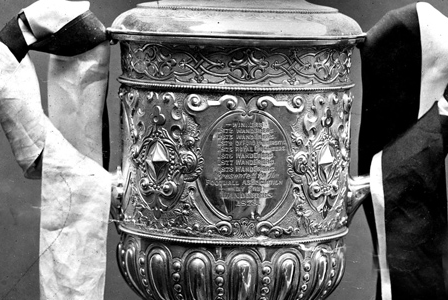 So on Monday the 26th of October 1863 The Football Association was formed. The first and therefore oldest football association in the world, often referred to simply as The F.A. and with no 'English' prefix. Today the F.A. oversees all aspects of the amateur and Professional game and is responsible for the management of the men's, women's, youth and national football teams. It is based at Wembley Stadium, London. All English professional teams are members of The F.A though it does not control day to day running of The Premier League. In the early days the F.A's membership (about 50) was quite small and its authority was often challenged or ignored completely. It's main rival in Sheffield had a membership of 26. Throughout the country though, new clubs were being formed, playing F.A.,Sheffield or mixed rules. The game of football was evolving quickly now with formations and tactics gradually being introduced. On the 20th of July 1871 a meeting was held at the offices of The Sportsman newspaper when Charles Alcock (F.A. Secretary,1870-1895) proposed a knockout competition open to all F.A. member teams, partly in an effort to promote the F.A. The first ever cup competition however was The Youdan cup held in Sheffield and played under Sheffield rules It was named after and sponsored by Thomas Youdan,a Sheffield theatre owner who provided a trophy and a prize of £2. The final was held at Bramall Lane on the 5th of March 1867 in front of 3000 spectators paying 3d admission and won by Hallam F.C. The cup was lost until 1997 when Scottish antique dealer contacted Hallam F.C. who subsequently paid £2000 for it. The F.A cup is the oldest national football association tournament in the world.The first matches were played 11/11/1871 with only 15 clubs entering. There were only 12 matches played in total, with many byes and walkovers and contested by teams from the London area only due to the cost of travel. The final was held at the Kennington Oval, London with 2000 spectators paying 1 shilling. Wanderers, an amateur team made up mostly of ex public school and university members and founder members of the F.A. beat the Royal Engineers, a British Army team, 1-0. The Royal Engineers were considered favourites but one of their players broke his collar bone and substitutes weren't allowed in those days. The Royal Engineers were the first football team to 'tour', playing games in Sheffield, Nottingham and Derby in 1873. The following year 26 Teams entered, though 6 withdrew and Wanderers were given a bye to the final. In the1875/6 season the number of entrants rose to 29. The competition was slowly growing with teams throughout the UK now taking part. One very important factor now was that for a team to take part it had to agree to play under Association rules. The popularity of football as a participation and spectator sport was now becoming evident as by the 1888 final it was watched by 22000 people. In the 2011/12 season there were 763 teams entered making it the largest such competition in the world. This is a convenient point to close for now as we have reached the point of my next subject, which will be the formation of the Football League and professionalism. I've tried to limit the article to the main aspects of the development and history of football and if any member has any questions or comments please feel free to do so on the links below and I will do my best to give a satisfactory response. In the mean time here are a few random statistics; Most F.A. Cup Final appearances and wins - Manchester United - 18 apps, 12 wins. Most appearances in final without winning - Leicester City. Biggest win in tournament - Preston North End 26 - Hyde (1st round 1887). Biggest away win in tournament - Clapton 0 - Nottingham Forest 14 (1st round 1891). Highest attendance - 126,047 Bolton Wanderers v West Ham - Wembley - 28/4/1923. Preston N. E. achieved the first double (league and cup) beating Wolves 3-0 in 1889. Notts County have appeared in 2 F.A. cup finals, losing the first on 23/3/1891 3-1 to BLackburn Rovers at The Oval, even though they had beaten Blackburn 7 - 1 only one week previously. Notts did win the cup, though, on 31/3/1894, beating Bolton wanderers 4 - 1 at Goodison park.Jimmy Logan became the second player to score a hat trick in the final and Notts becoming the first team outside the top division to win having finished 3rd in Division 2. Henry 'Harry' Cursham scored the most F.A. goals in a career period from 1877-18, a total of 49 goals whilst playing for........Notts. Biggest cup final score - Bury 6 - Derby County 0. The Rams had appeared in 2 finals previously, losing 3 - 1 to Nottingham Forest in 1898 (another unwanted statistic) and again losing 4 - 1 to Sheffield United. The 1945/6 season had no league programme so for the only time in its history the F.A. cup was played over 2 legs up to the semi final and final. In a semi final replay at Maine Road, Manchester, Derby beat Birmingham City 4 - 0 in front of 80,407 spectators, a midweek record attendance between league clubs. The Rams went on to beat Charlton Athletic 4 - 1 after extra time. So to make up for all the unwanted records I would like to claim that Derby County are the only true winners of the F.A. cup. Discuss the Series - Super Rams Articles in the Community. Previous Article | 150 Years of Football
 -
Glad you enjoyed, Tony. I like your idea. You could take it further and not have a goal at all in your own half, making it impossible for the opposition to score.
-
Yes he's a great little character, as are all the grandkids. A very nice post.
-
Thanks Liam, Glad you enjoyed .
-
An interesting few months ahead, a few months that will define fans hopes for next season. There are many clubs in the same predicament as Notts. At last people are becoming aware of the fact that clubs can't just spend money that they don't have. Thanks for a very good post
-
Cheers James, I'm learning new things myself! It's the origin of the F.A.cup next in about a week.so keep a lookout for it please.
-
Thanks, Joe ,for keeping me up to date with another of your great match reports and thanks also for all your other enjoyable posts.
-
We have to remember that communication was very slow in the 1800's. Nowadays something appears on the television and everybody knows about it the same day. There were a lot of other factors that impeded all sport development which I hope to highlight as the series of articles progresses. I'm discovering things and I hope others do too. Glad you enjoyed it.
-
 A short while ago I wrote an article about Notts County's 150 year existance, which I will link to at the bottom of this article for any readers to catch up on (if you choose to do so). Here is the second in the series of posts, where I've tried to describe the development of 'football'. Of course there are other codes of 'football' that grew out of 'mob football' in the mid/late 19th century. I've concentrated on the growth of football as we now know it in England, I hope you all find it interesting and any comments are again most welcome, so please get posting. In 1857 Sheffield FC was formed by members of Sheffield Cricket Club as a way of keeping fit during the winter months, so becoming the worlds oldest club playing Association football. (Notts now being a professional league side) They began just playing games between club members and in 1858 laid down the rules by which they would play, these became known as The Sheffield Rules. Hallam FC was formed in 1860 and soon there were at least 15 teams playing in the Sheffield area. Now inter club games were being organised and it became necessary to have a governing body to administrate these clubs. Thus in 1867 The Sheffield F.A. was created, becoming the first county association in England. Sheffield FC v Hallam FC is the oldest derby match still being played. Sheffield FC played an eighteen a side game in Nottingham under Nottingham rules on the 2nd of January 1865, their first game outside the Sheffield area. Football was also developing all over the country particularly in the London area and in public schools, however when inter-team matches were arranged there was a good deal of confusion regarding rules of play, One way round this was to play one half of a game using one teams rules and then use the other teams rules for the second half. This was obviously unsatisfactory. Also when pupils moved from school to university there was confusion about the rules of play. So in 1848 a compromise set of rules was formulated. These became known as The Cambridge Rules and were revised in1856.The rules included throw ins, goal kicks, forward passing and no running while carrying the ball. In 1862 Ebeneezer Cobb Morley founded Barnes FC (London) and being concerned about disputes over rules wrote a letter in 1863 to the Bell's Life newspaper suggesting that an association similar to the MCC in cricket be formed to decide set rules and govern football. So on the 26th of October 1863 a meeting was arranged at The Freemasons Tavern, Great Queens Street, London,with representative of several public schools and interested parties in attendance. Over a series of 6 meetings rules were drawn up by Mr. Morley using the Cambridge rules as a basis but also incorporating some of The Sheffield rules and others and favouring dribbling and kicking the ball rather than handling and running whilst holding the ball. As a result of the handling and other rules being removed the representative of Blackheath withdrew his team from the FA. Several other clubs soon followed suit and later in 1871 formed The Rugby Football Union. So now we have Rugby football and Association football or 'Soccer', a corruption of association. Sheffield FC joined the FA in November 1863 but continued to use their own rules until 1878 when the FA incorporated some further Sheffield rules. The game of football (Soccer) was now becoming recognizable as the game we know today but there was still quite a way to go. To be continued soon. Discuss the Series - Super Rams Articles in the Community. Previous Article | Notts County - 1862
 -
-
Thanks for bringing me up ta date with your post, Joe.I was listening to the Rams losing at Blackburn but I know I can rely on you to give an accurate, unbiased report.You've not let me down. Thanks again.
-
It sounds like everyone had a really memorable time.I know you and Jake certainly did. Amazing, (to borrow your word) the bonds of friendship that come about through football. I wish the press/media would publicise this kind of event more.
-
Glad you enjoyed the article , weymouthPIE .I , myself , have learnt a lot just by reading the posts on this site .A lot of the posts make fascinating reading .
-
Sincere thanks to all for your kind comments I hope you all payed attention, particularly you, Mr. Hateley, I may be asking questions later.
-
I'm not fishing but do understand a bit more how you feel when you get a bit down about the site. I'm also getting a good feeling with the responses so far. Roller coaster ride. I'm up at the moment. And of course your opinion is always valued.(though not always agreed with) It's usually me encouraging you and the reversal is much appreciated.
-
I am actually quite nervous waiting for a response, any response, apart from yours, Joe. I would have liked to give a more detailed write up but we can probably enlarge as members respond(if they do)
-
 I have now written a brief introductory article about football up to the time of Notts formation in 1862 and will continue with more:-i.e. The formation of the F.A. and Football League and come up to date with, hopefully, interesting and informative articles. I enjoy reading about the history, players, and ups and downs of other clubs. I hope other site member do also and will add their own comments to give us all a better insight into football's rich history. Notts-Joe has asked me to write up about the history of football, not just relating to Notts County. On 28th of November 2012 Notts County celebrated 150 years of existance. Notts formation came about 50 years before The Titanic sank, 26 years before Jack the Ripper found notoriety. Across the Atlantic the American Civil war was being fought(1862-1865), Here in England, in the middle of Queen Victoria's reign, great things were happening.The lives of people in England were soon to be changed and then the whole world. The phenomenon we call Football was about to explode. Football was much different back in Dickensian Britain. Games involving ball like objects have been played for centuries. Football evolved as Mob Football and in the Middle ages every town or village would play it's own version, usually on public holidays. A good but watered down example of this is still played in Ashbourne each Shrove Tuesday and Ash Wednesday. There were no set rules and often resulted in injury and damage to property. Many Kings have tried to prohibit football over the centuries, for various reasons, but football in some form would not go away. The industrial revolution in the 1700's brought about improved methods of manufacture and production It also helped change Britain from a rural to an urban country with rapid growth of populations in cities and towns particularly in Lancashire, Yorkshire and The Midlands. The workers were now being employed in large factories instead of their own homes and it's not too difficult to imagine impromptu games taking place after work. Public schools also had developed differing styles of ball games. These were often more like Rugby with a mixture of kicking and throwing and encouraged as character building. The first signs of teams being formed were beginning to be seen and with the coming of the railways by the mid 1800's, cheaper public transport was available.Another revolution was about to take place and NOTTS COUNTY would be at the forefront. To be continued - Discuss Super Rams Series in the Community.
 -
Too many fans are fickle -not on here ,thankfully. There are a lot of experts who seem to know everything about everything but if you asked them to put their hands in their pockets like Ray Trew ( and others in football) they start making excuses and shifting the blame.Every fan wants to see their team winning things or at least having a good go at winning things.We can't all be winners ,there has to be losers too.The fair weather supporters are often the loudest moaners.
-
Your illness hasn't affected your writing. Once again a lovely, iinformative, easily read account.Thanks once more and I hope you're feeling better very soon.